Port forwarding is a relic — how developers actually expose localhost in 2026
Ask a developer from 2005 how to make your local server reachable and they'll say port forwarding. Log into your router, find the admin panel, map external port 8080 to your laptop's 3000, done. Except it was never done — it was the start of a cascade of problems.
First, your router fights you. Admin panels are buried, settings differ per manufacturer, and half the time your ISP has you behind CGNAT — carrier-grade NAT — which means your "public" IP isn't actually yours and forwarding simply doesn't work. No fix, no workaround, dead end.
Second, it's a security decision you didn't mean to make. An open port on your home network is an open port on everything behind it. You're not exposing your dev app; you're exposing your house. Shodan indexes it within hours.
Third, it solves the wrong problem. Modern development needs HTTPS for OAuth callbacks, stable URLs for webhook registration, and access that expires when the task does. Port forwarding gives you none of that. It gives you a raw hole, permanently, with your home IP attached.
The replacement is the tunnel: an outbound connection from your machine to a relay, which gives you a real public URL with real TLS — no router access needed, no inbound ports open, works behind any NAT. Your network stays closed; only the tunnel speaks.
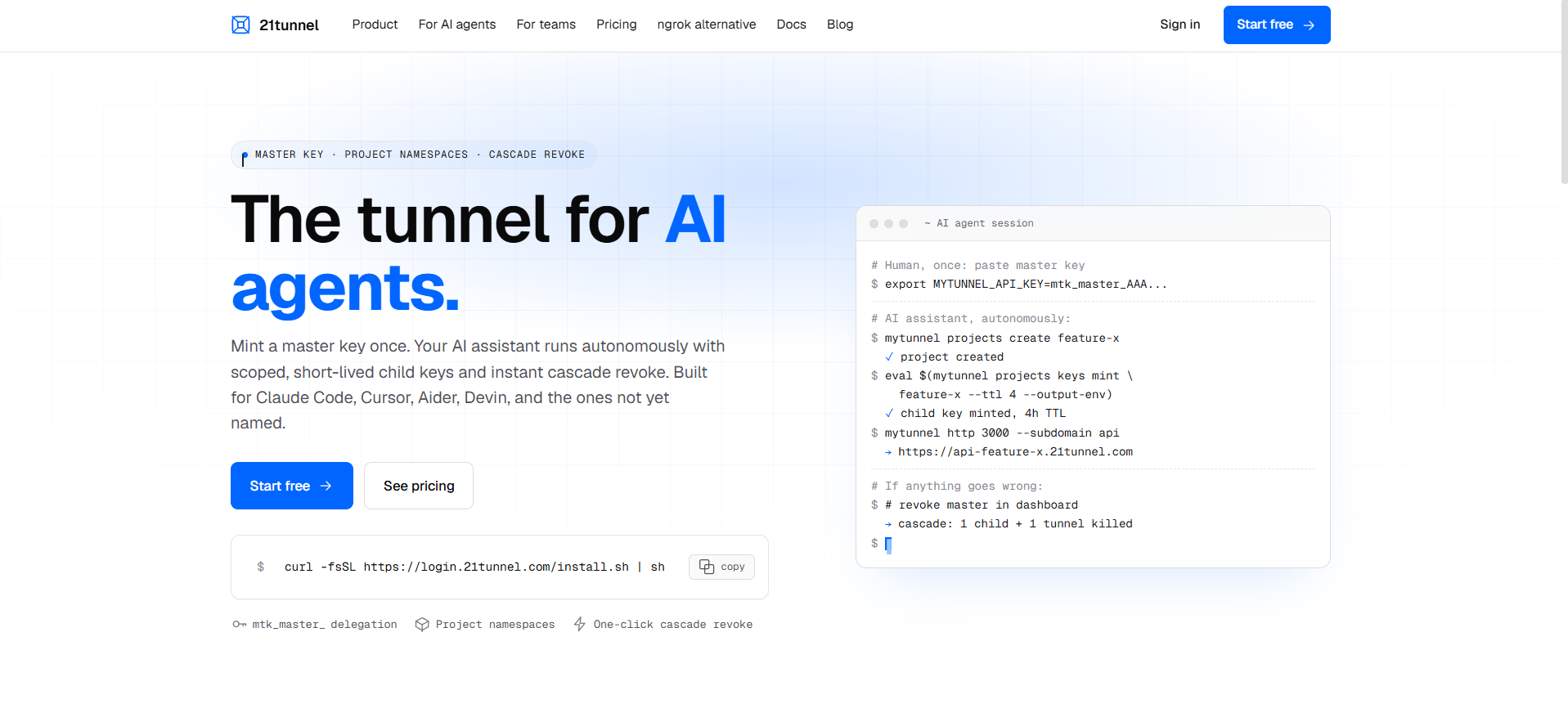
And the modern version goes further: stable subdomains that survive restarts, scoped keys that open exactly one tunnel (what you hand to an AI agent or a contractor instead of your master credentials), and edge auth that gates the URL behind sign-in. That's the shape we built into 21tunnel — open source, one command. Cloudflare Tunnel and ngrok follow the same principle.
Port forwarding had a good run. But the job changed, and the tool didn't.